The word "apology" does not appear anywhere in the communiqué that Commonwealth leaders issued in Antigua and Barbuda on 4 November 2026. Nor does "compensation". The document runs to 18 pages, and both words are absent from all of them, according to the Commonwealth Secretariat's text.
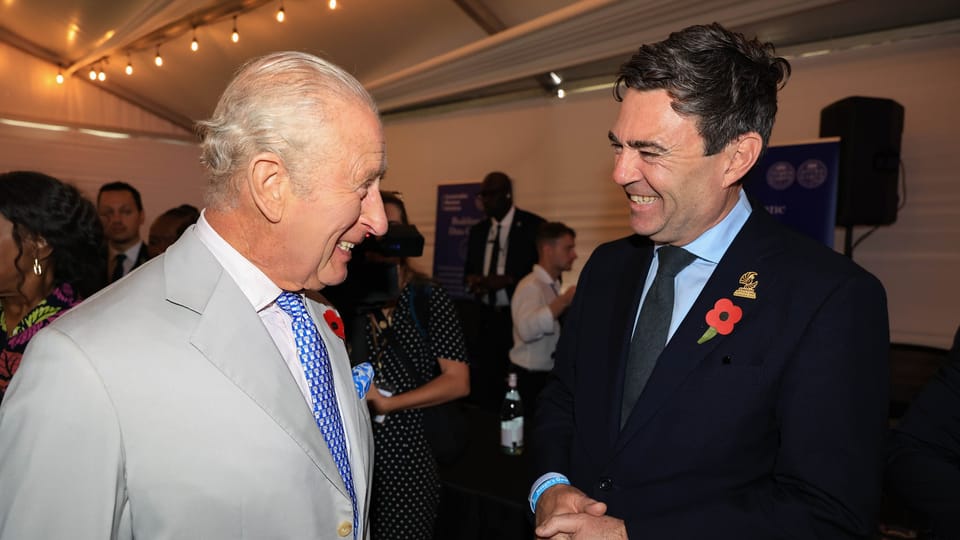
It was issued the day after King Charles told the summit that the slave trade was "a monstrous injustice", in a speech reported by AFP, in a copy on Africanews. The same report says Andy Burnham, the prime minister, had written that he was open to a formal apology on behalf of the British state. He ruled out financial reparations, which he called "not the right answer".
The week therefore produced three things that stop short of an apology: a sovereign's sorrow, a prime minister's openness and an agreement to talk. The gaps between them are not only diplomatic caution. They follow a fault line that Hannah Arendt drew with unusual care, between guilt, which is personal, and responsibility, which can be political and shared. An apology from a state belongs to the second category. Burnham is half right that British people today should not be "held liable for historical wrongs, however heinous", because no living person is guilty of the trade. He is wrong if he treats that as an answer to the claim of responsibility. And the King's observation that the past cannot be changed is a reason to act, not a reason to stop.
What was said, and what was issued
Start with the King's words, which reached the public in fragments. According to AFP, in the copy on Africanews, he said that "that shameful chapter of history is one that fills my heart with horror". He added that it "still casts a shadow over these islands and other members".
Al Jazeera, carrying AP material, reported that Charles spoke of "the most profound personal sorrow". It also quoted him on the limits of any such statement: "We cannot change the actions of those who came before us," Charles said. "We can, however, learn from the past." The same page reports that the palace said the King would not issue a formal apology. It also carries Burnham's wish, as AP put it, "to express my sorrow and regret for the pain and suffering of so many millions of people".
Set that beside the document the leaders issued. The communiqué records that the heads of government "met in St. John's, Antigua and Barbuda, on 1-4 November 2026". Its section headed "Reparatory Justice", paragraph 47, says the leaders "agreed the time had come for meaningful, truthful and respectful conversation towards forging a common future based on equity." It then welcomes the agreement of the United Kingdom government to engage in "a structured, time-bound, inclusive and good-faith dialogue" on "addressing the transatlantic trafficking of enslaved Africans and its historical harms."
The same paragraph notes a resolution of the UN General Assembly, A/RES/80/250, whose title describes the trafficking of enslaved Africans as "the Gravest Crime against Humanity". The vocabulary of condemnation is strong. The vocabulary of remedy is thinner: a conversation, with a clock on it, and no named outcome.
That is the shape of the problem. Three kinds of speech are on offer: personal sorrow, a government's willingness to hear a demand, and a negotiated process. Missing is a sentence spoken by the state itself. A section titled "Reparatory Justice" that contains neither an apology nor any compensation tells the reader how far the parties have travelled so far, which is to the point of agreeing to talk. Whether the missing sentence would repair anything, or merely acknowledge what happened, is the question this essay takes up.
What Arendt meant by forgiveness
Arendt's account begins with a problem about action. Whatever people do, they cannot undo. In The Human Condition she argues that without a way out, we would be "confined to one single deed from which we could never recover", in the words of the passage as quoted by the Hannah Arendt Center at Bard (the blog gives the page as 237). The faculty that releases people from that confinement, she says, is forgiveness.