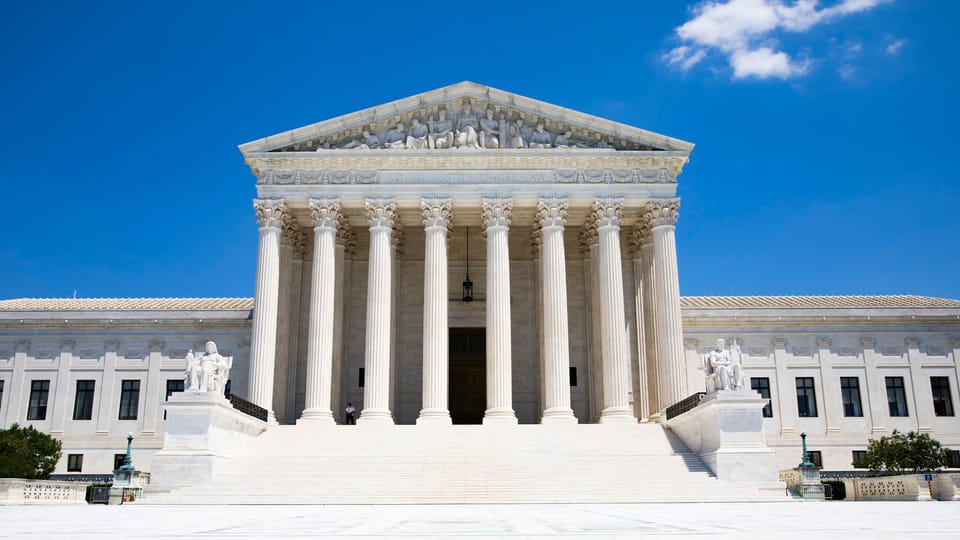
The Supreme Court is deciding whether Colorado can keep two Catholic preschools out of its state-funded universal preschool programme because they object to its nondiscrimination rules on sexual orientation and gender identity. It heard argument in St. Mary Catholic Parish v. Roy, No. 25-581, on 3 November 2026. No decision has been issued.
The most striking exchange came from the lawyer for the schools. Chalkbeat Colorado reported that Nicholas Reaves, of Becket, told the justices that if refusing students was the schools' "sincere religious exercise," then "I think that would be permitted." That answer shows how much the case could carry beyond preschool funding, and why the Court's actual questions are narrower than the argument made them sound.
What is the dispute about?
Colorado's universal preschool programme funds preschools that are "public, private, and religious alike," in the words of Erwin Chemerinsky at SCOTUSblog. Participating schools must give children an "equal opportunity to enroll." Chalkbeat Colorado, reporting from the argument, says more than 2,000 preschools take part, including other religious schools that agreed to the rules.
The two Catholic preschools wanted in but objected to the rules on sexual orientation and gender identity. The state declined to give them an exemption. They sued, lost in the Tenth Circuit on 30 September 2025 (No. 24-1267), and petitioned the Supreme Court on 13 November 2025. The Court granted review on 20 April 2026, limited to the first two questions in the petition, according to the supremecourt.gov docket.
What exactly will the Court decide?
SCOTUSblog gives the two questions in Chemerinsky's wording. The first asks "[w]hether proving a lack of general applicability under Smith requires showing unfettered discretion." The second asks whether Carson v. Makin displaces the rule of Smith only when the government explicitly excludes religious people and institutions.
Both are questions about when a government rule triggers closer scrutiny. Neither is, on its face, a question about preschool. Whichever way the Court answers, the opinion will set a test for lower courts. Colorado's programme is only the occasion.
What does Smith still say?
Employment Division v. Smith, 494 U.S. 872, was decided on 17 April 1990. Chemerinsky summarises its holding as "that the First Amendment does not provide a basis for religious exemptions from general laws." The opinion's own phrase for the laws it covers is "valid and neutral law of general applicability," which is why the first question turns on what "general applicability" means. If a rule is not generally applicable, Smith does not protect it.
Smith has not been overruled. Petitioners want it overruled, and Chemerinsky says Justices Alito, Thomas and Gorsuch urged that in Fulton. But the St. Mary's brief, as he quotes it, also says the "Court rarely applies Smith." That is a different and more modest argument: that the rule survives mainly on paper, and that the schools can win without the Court formally burying it.
What is each side's best case?
On SCOTUSblog's account of its brief, Colorado argues that "its law does not discriminate based on religion." The state pays for children to attend religious preschools, the account continues, provided the schools do not discriminate on parents' sexual orientation or gender identity. At argument, Chalkbeat reports, Helen Norton, the state's Deputy Solicitor General, said the interest is giving families "equal opportunity, not some opportunity."
The petitioners' case, as SCOTUSblog describes it, is that the Court should either overrule Smith or confirm how seldom it governs. At argument Reaves put the second half of that position in a general form. According to Chalkbeat he said: "You can imagine situations where the government is keeping out religious schools." The United States, through Principal Deputy Solicitor General Sarah M. Harris, supported the petitioners, the docket shows.
The two sides therefore disagree about what counts as exclusion. Colorado says a condition applied to every provider is not exclusion. The schools say a condition that only they cannot meet in good conscience shuts them out in practice.
What did the justices ask?
Chalkbeat's recap records questions, and questions are not votes. Justice Sotomayor asked: "Your Catholic schools will reject a child merely because their parents are homosexual?" Justice Kagan asked why religious people should get "a special accommodation" when the law treats them the same on its face, and noted that recent cases involved rules that explicitly treated religious schools differently.
Justice Alito compared the case to hypothetical bans on head coverings or on the slaughter of conscious animals. Justice Jackson asked whether the same logic would let a school exclude children on race or ethnicity. These are tests of the line each side wants drawn. Kagan's question goes to the second question presented, and Jackson's to the limits of Reaves's answer.
Where does Locke fit?
The petitioners' instinct has an old source. In A Letter Concerning Toleration (1689), John Locke argues that civil government exists to protect civil interests, and writes that "the care of souls is not committed to the civil magistrate, any more than to other men." The line is on Wikisource. A church, on this view, answers for its teaching to something other than the state, and the state cannot press it to change.
That is the schools' claim at its strongest. Our reading is that it also marks where Locke stops helping. His principle is about the magistrate commanding belief. Colorado is setting the terms of a funded programme and says it does not discriminate on religion. Whether a funding condition is the magistrate reaching into souls, or a rule that happens to bind a church, is the question the Court's two questions leave open. Locke explains the claim. He does not decide the case, and nobody should say he would.
What is the strongest objection?
The objection to the schools is that the Locke-style claim proves too much. Smith was written to answer it: if conscience excused every generally applicable duty, each believer would hold an exemption of his own. Kagan's phrase "a special accommodation" and Jackson's question about race are the same worry in the courtroom. Reaves's admission that refusal on sincere religious grounds "would be permitted" is the answer the objection predicted, and it is the part of the schools' case Colorado has most reason to press.
The objection to Colorado is that "equal opportunity" is a description the state gives its own rule. If a rule keeps a particular religious school out in practice while admitting others that accepted it, the first question asks whether that is general applicability or exclusion. The sources do not tell us which view the opinion will take, and we do not guess.
Where to read next
- SCOTUSblog: Erwin Chemerinsky's preview of the case, dated 20 October 2026, with both questions and each side's argument.
- Chalkbeat Colorado: Ann Schimke's account of the 3 November argument, source of the exchanges quoted above.
- Cornell LII: the text of Employment Division v. Smith.
- supremecourt.gov: the docket for No. 25-581.
Chalkbeat reports that a decision is expected by the end of June. Watch for whether the opinion treats Carson as limited to explicit exclusions, and what it says about Reaves's answer on refusing students.