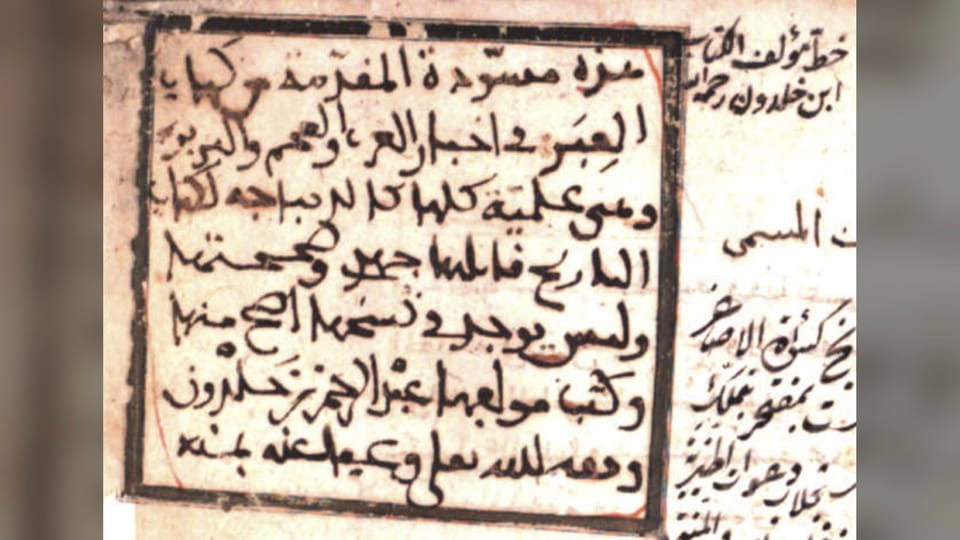
Asabiyyah is Ibn Khaldun's term for group feeling: the solidarity, rooted in kinship and religion, that lets a people win and hold political power. In his Muqaddimah it founds a dynasty, and the luxury that follows a dynasty's success wears it down. Linda T. Darling notes that conquerors without it are absorbed by those they conquer.
Definition
The word is also spelt 'asabiyya or asabiyah. Ibn Khaldun (1332-1406) used it for the bond that makes a group act as one. Darling summarises his analysis as a correlation between 'asabiyya, social cohesion or group feeling, and political power. In her words, "the glue that held societies together was 'asabiyya, based on kinship and religion".
The dynastic cycle
The Muqaddimah is blunt about the first step. In Franz Rosenthal's translation, "A dynasty can be founded and established only with the help of group feeling."
Success then works against the thing that produced it. As a dynasty settles into power, Ibn Khaldun writes, "The inner circle, thereafter, weakens, because luxury undermines it". The result: "The group feeling that the ruler had through them is destroyed." The dynasty is then open to a new group that still has what the old one lost.
The cycle is short. Wolfgang G. Schwanitz, reviewing Robert Irwin's biography, reports that Ibn Khaldun counted four generations from founding to doom.
Darling's point on conquerors
Darling applies the idea to what happens after a conquest. "Conquerors whose social cohesion was weak were soon overcome by the civilization of the conquered," she writes. Strong cohesion had the opposite effect: it allowed royal authority to pass to a second branch of the ruling family without the dynasty breaking up.
Asabiyyah is therefore a claim about the aftermath, not the victory. A group that holds together keeps its identity and its rule. One that does not is assimilated.
Where the concept is contested
The concept is built on the societies Ibn Khaldun knew, and its critics question how far it travels. The sociologist Sinisa Malesevic has published a paper whose abstract states: "In this paper I offer a critique of Ibn Khaldun's and Gellner's theories of social cohesion".
Syed Farid Alatas raises a different complaint. A Global Social Theory entry says he suggests that "eurocentrism in the social sciences stands in the way of acknowledging the relevance of the non-Western theories". That is a charge against how Western sociology has treated Ibn Khaldun, not against asabiyyah itself. Our reading: the dispute with Alatas is over who may use the concept, not over what it says.
Sources
- University of Arizona (Experts): abstract of Linda T. Darling, Social Cohesion ('Asabiyya) and Justice in the Late Medieval Middle East, Comparative Studies in Society and History 49(2), April 2007.
- Center for a New Economics: excerpt of the Muqaddimah in Franz Rosenthal's translation.
- Middle East Quarterly: Wolfgang G. Schwanitz's review of Robert Irwin, Ibn Khaldun: An Intellectual Biography, Fall 2019.
- Filozofija i drustvo: Sinisa Malesevic, "Warfare and Group Solidarity: from Ibn Khaldun to Ernest Gellner and Beyond", 2021.
- Global Social Theory: entry on Syed Farid Alatas.
- Wikipedia: Ibn Khaldun's life dates only.
Cover image: Autograph folio of Ibn Khaldun's al-Muqaddima, MS Atıf Efendi 1936, f. 7a, Süleymaniye Library, Istanbul. Public domain (Wikimedia Commons).