“We are not going to regulate artificial intelligence.” Javier Milei said so to the US Chamber of Commerce in Washington last month, and added: “We are going to leave it free.” Both sentences come from an AP report carried by Euronews, published on 2 November 2026.
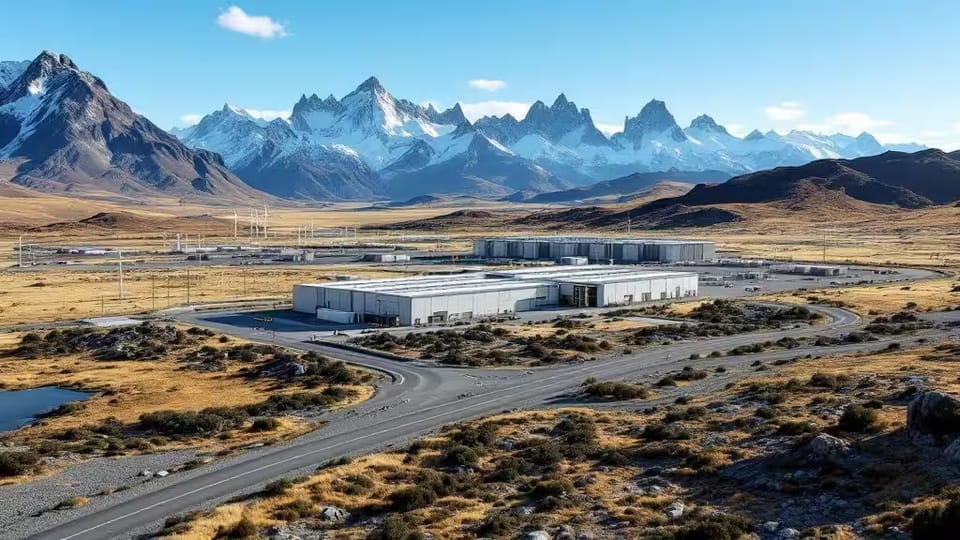
The offer has an address. In Chubut province, in Patagonia, 14 landowners have leased a combined 130,000 hectares, about 321,000 acres, to Green Capital, a Polish renewable-energy company. It plans a $3bn (€2.7bn) data centre there, to be leased on to big technology firms. It has no customer yet, and construction is not expected until around 2028.
A Reuters report carried by The Star of Malaysia, from September, places the leased land south of Trelew, in an area of roughly 1,298 square kilometres for wind and solar farms. It gives the first stage as 300 megawatts costing $3bn, with a possible 3,000 MW to follow.
Congress is being asked to sweeten the offer. The AP describes an incentive scheme, awaiting Senate approval, that would cut the corporate income tax rate to 15% from 25% for projects of at least $1bn. It would apply to any project above that threshold, not only Green Capital’s. Nothing in it would require companies to reserve computing capacity for local use, or to disclose how much energy and water they consume.
Key facts
Land: 130,000 hectares in Chubut leased by 14 landowners to Green Capital.
Project: a $3bn (€2.7bn) data centre; no customer yet; construction not expected until around 2028.
Tax: a 15% corporate rate instead of 25% for projects of at least $1bn; awaiting Senate approval.
Not required by the incentives: local use of computing capacity, or disclosure of energy and water use.
Not found in any source we read: figures for jobs, local tax revenue or water use.
What the Chubut lease puts on the list
Marta Zlotkowska, head of international development at Green Capital, says the company “compared potential locations for the project around the world”. She gives the reason Patagonia won: “In densely populated parts of the US and Europe, there’s a lot of fighting over access to the grid.” Patagonia offers empty land, with cool air and strong winds, and gas from the Vaca Muerta shale formation. A firm that tests two continents for grid access is behaving as its shareholders would expect.
By the AP’s own calculation, the finished campus would use, at projected peak demand, about 2.7 times the electricity the city of Buenos Aires consumed in 2025. That campus is not the $3bn first stage, and the reports do not say how the two relate.
Demand explains the hunt. According to the IEA’s executive summary, data centres drew about 1.5% of world electricity consumption in 2024, roughly 415 terawatt-hours, and the figure is expected to more than double to about 945 TWh by 2030. Companies that need power on that scale look for room to build it.
Chubut has rivals. Reuters lists a Pampa Energia proposal in Neuquén of up to 500 MW using Vaca Muerta gas, and a project by OpenAI and Sur Energy of up to $25bn and up to 500 MW, announced in October 2025. Visitor logs reviewed by the AP show meetings between Argentine officials and representatives of OpenAI, Amazon, Google, Oracle and data-centre companies. Crusoe, which helped build OpenAI’s flagship Texas campus, sought talks with energy officials about US government-backed investments.
Alan Rocha Varsanyi, a researcher at Observatorio Petrolero Sur, says: “We’re not talking about data centres designed to strengthen Argentine technological sovereignty.” In his account the computing capacity will be exported to wherever the companies need it, while Argentina supplies land, wind and gas and, if the Senate agrees, a lower tax rate.
Heidegger’s Rhine and Chubut’s wind
Martin Heidegger’s essay on technology opens by denying that it is about machines: he writes, in William Lovitt’s translation, that “the essence of technology is by no means anything technological” (The Question Concerning Technology and Other Essays, Harper & Row, 1977, p. 4). That essence is a way of revealing the world.
Modern technology, he argues, reveals nature by challenging it, and the challenge takes the form of a demand: it “puts to nature the unreasonable demand that it supply energy that can be extracted and stored” (p. 14). A tract of land, he says, “is challenged into the putting out of coal and ore”, and agriculture “is now the mechanized food industry” (pp. 14–15), whereas the old windmill “does not unlock energy from the air currents in order to store it” (p. 14).
His central example is the Rhine. A hydroelectric plant “is set into the current of the Rhine”, and the river appears as “something at our command” (p. 16). Whatever is treated so becomes what he calls standing-reserve, in German Bestand: “Everywhere everything is ordered to stand by, to be immediately at hand” (p. 17). It “no longer stands over against us as object”, and counts only for what it can supply.
Martin Heidegger
Modern technology is a way of seeing that orders everything, rivers and people included, as stock on call (Bestand). The gathering claim behind it he calls Gestell, or Enframing.
Read: “The Question Concerning Technology”, in The Question Concerning Technology and Other Essays, trans. William Lovitt (Harper & Row, 1977)