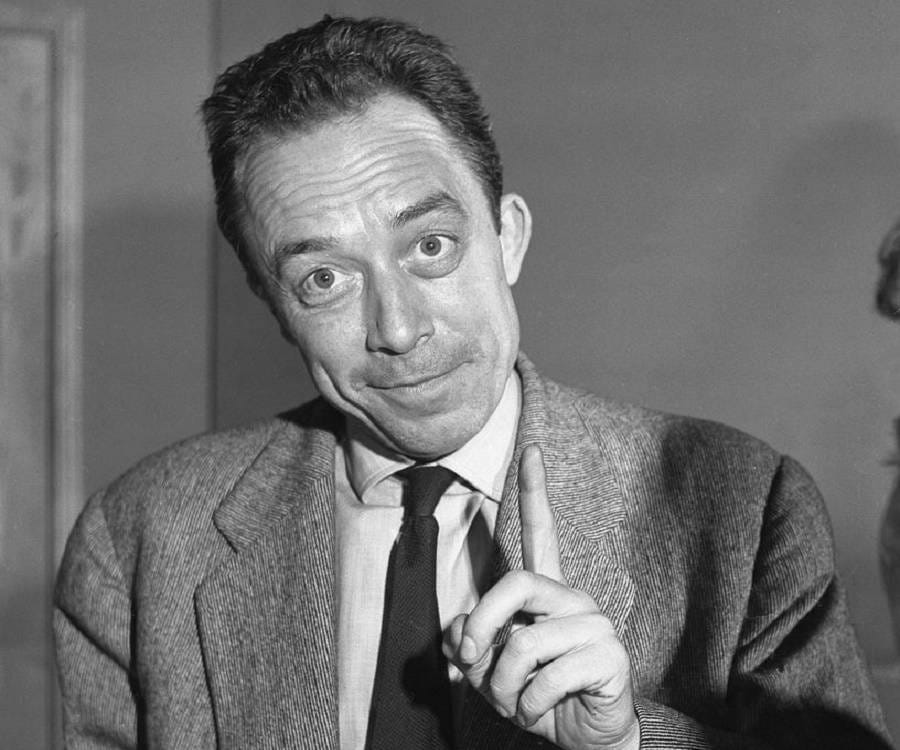
For Camus, the absurd is neither a fact about the world nor a mood in us. It arises when a mind that demands meaning meets a world that gives no answer. Because it needs both sides, suicide and false hope both escape it. Camus answers with lucid revolt, freedom and passion.
Begin with the moment almost everyone skips. Sisyphus has pushed the stone to the top of the mountain. It rolls back down, as it always does. The story usually stays with the effort and the strain. Camus looks somewhere else.
"It is during that return, that pause, that Sisyphus interests me." (Camus, The Myth of Sisyphus, trans. O'Brien)
So picture the descent. His hands are empty. Nothing is required of him for the length of the walk. He knows exactly what waits at the bottom and exactly how it will end. What is he thinking about? Camus gives that interval a name.
"That hour like a breathing-space which returns as surely as his suffering, that is the hour of consciousness." (Camus, The Myth of Sisyphus, trans. O'Brien)
The whole essay is built to explain why that hour, and not the pushing, is where the meaning of the myth lies.
What this episode argues
- The absurd is a relation, not a thing. It exists only where a questioning mind meets a silent world.
- Both standard exits, physical suicide and what Camus calls philosophical suicide, make the absurd disappear by deleting one side of that relation. Neither of them answers it.
- "One must imagine Sisyphus happy" is best read as a wager about how a life can be lived, not as a conclusion that follows from premises.
The first move
Camus opens with the bluntest question he can find.
"There is only one really serious philosophical question, and that is suicide." (Camus, as translated in the Stanford Encyclopedia of Philosophy)
He is not recommending it. He asks the question in order to refuse it, and the refusal depends on getting one distinction right. He does not claim that the world has no meaning. His claim is narrower, and more honest.
"I don't know whether this world has a meaning that transcends it." (Camus, The Myth of Sisyphus, trans. O'Brien)
The absurd begins in that gap between wanting to know and being unable to. Take away the mind that wants, and there is no absurd. A stone does not find its situation absurd. Take away the silence, and there is no absurd either. A world that answered every question would leave nothing to confront.
Here is a concrete case. Someone loses a person they love and asks why. They can respond in three ways. They can stop asking by ending the life that asks. They can accept an answer that makes the loss part of a hidden plan they have no means to check. Or they can keep the question open and go on living with it. In Camus's terms, the first removes the mind. The second removes the silence by leaping past it, and that leap is what he calls philosophical suicide. He aims the charge at Kierkegaard, Shestov and Jaspers, thinkers who share his starting point but turn to hope.
"But this does not imply a judgment." (Camus, on philosophical suicide, The Myth of Sisyphus, trans. O'Brien)
The point concerns intellectual honesty, not the worth of believers. Only the third response keeps both terms of the absurd in play, and Camus calls that stance revolt. Sisyphus on his walk down is its image. He has no illusion and no exit, and he is fully awake.
The argument is clean so far. What it has not yet shown is why that wakefulness should feel like defiance rather than a shrug, and a philosopher writing three decades later thought the difference was the whole question.
This essay is for subscribers only
Join our community to read the full version and unlock the archive.
Subscribe Now